Welcome to the Homepage of the UBC Classical, Near Eastern, and Religious Studies Students Association
UBC Classical, Near Eastern and Religious Studies Students' Association:
[Home] [About Us] [Grad Photos] [Executive]
[Home] [About Us] [Grad Photos] [Executive]
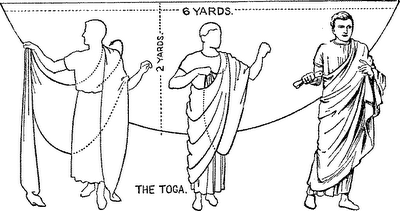
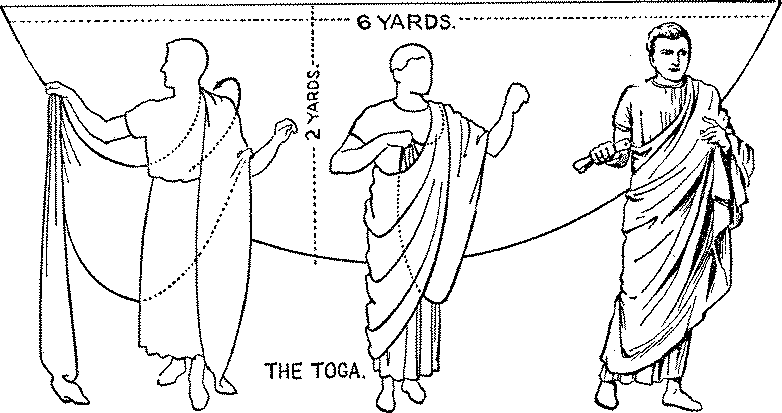
The toga was a distinctive garment of Ancient Rome. It consisted of a long sash of cloth, ~6 m in length. This sash was wrapped around the body in a particular way, and was generally worn over a tunic. The toga was invariably made of wool, even if the tunic it was worn over was often made of linen. For most of Rome's history, the toga was a garment worn exclusively by men, while women wore the stola. Non-citizens were forbidden to wear a toga.
CNERS SA 2nd ANNUAL TOGA PARTY!
7:00 - 11:00 p.m.: BUCHANAN A 200
Cheap Beer | Wine | Cider !
Come in a toga -- we have safety pins!
Prizes for best male & female togas!
Because the toga was not worn by soldiers, it was regarded as a sign of peace. Cicero's De Officiis contains the phrase cedant arma togæ: literally, "let arms yield to the gown", meaning "may peace replace war," or "may military power yield to civilian power."

It doesn't have to come to this!
CHOOSE YOUR OWN TOGA:
Toga virilis: A plain white toga worn on formal occasions by most Roman men of legal age, generally about fourteen to sixteen years and older.
Toga candida: "Bright toga"; a toga bleached to a dazzling white by chalk, worn by candidates for public office.
Toga praetexta: An ordinary white toga with a broad purple stripe on its border. It was worn by: 1. Freeborn boys who had not yet come of age; 2. All curule magistrates; 3. Ex-curule magistrates and -dictators, upon and apparently at festivals and other celebrations as well; 4. Some priests (e.g., the Flamen Diales, Pontifices, Tresviri Epulones, the augurs, and the Arval brothers); 5. During the Empire, the right to wear it was sometimes bestowed as an honor independent of formal rank; 6. According to tradition, the Roman King.
Toga pulla: Literally just "dark toga". It was worn mainly by mourners, but could also be worn in times of private danger or public anxiety. It was sometimes used as a protest of sorts—when Cicero was exiled, the Senate resolved to wear togae pullae as a demonstration against the decision. Magistrates with the right to wear a toga praetexta wore a simple toga pura instead of pulla.
Toga picta: This toga, unlike all others, was not just dyed but embroidered and decorated. It was solid purple, embroidered with gold. Under the Republic, it was worn by generals in their triumphs, and by the Praetor Urbanus when he rode in the chariot of the Gods into the circus at the Ludi Apollinares. During the Empire, the toga picta was worn by magistrates giving public gladiatorial games and by the consuls, as well as by the emperor on special occasions.
Toga trabea: According to Servius, there were three different kinds of trabea: one of purple only, for the gods; another of purple and a little white, for kings; and a third, with scarlet stripes and a purple hem, for augurs and Salii. Dionysius says that those of equestrian class wore it as well, but this is not borne out by other evidence.
Toga virilis: A plain white toga worn on formal occasions by most Roman men of legal age, generally about fourteen to sixteen years and older.
Toga candida: "Bright toga"; a toga bleached to a dazzling white by chalk, worn by candidates for public office.
Toga praetexta: An ordinary white toga with a broad purple stripe on its border. It was worn by: 1. Freeborn boys who had not yet come of age; 2. All curule magistrates; 3. Ex-curule magistrates and -dictators, upon and apparently at festivals and other celebrations as well; 4. Some priests (e.g., the Flamen Diales, Pontifices, Tresviri Epulones, the augurs, and the Arval brothers); 5. During the Empire, the right to wear it was sometimes bestowed as an honor independent of formal rank; 6. According to tradition, the Roman King.
Toga pulla: Literally just "dark toga". It was worn mainly by mourners, but could also be worn in times of private danger or public anxiety. It was sometimes used as a protest of sorts—when Cicero was exiled, the Senate resolved to wear togae pullae as a demonstration against the decision. Magistrates with the right to wear a toga praetexta wore a simple toga pura instead of pulla.
Toga picta: This toga, unlike all others, was not just dyed but embroidered and decorated. It was solid purple, embroidered with gold. Under the Republic, it was worn by generals in their triumphs, and by the Praetor Urbanus when he rode in the chariot of the Gods into the circus at the Ludi Apollinares. During the Empire, the toga picta was worn by magistrates giving public gladiatorial games and by the consuls, as well as by the emperor on special occasions.
Toga trabea: According to Servius, there were three different kinds of trabea: one of purple only, for the gods; another of purple and a little white, for kings; and a third, with scarlet stripes and a purple hem, for augurs and Salii. Dionysius says that those of equestrian class wore it as well, but this is not borne out by other evidence.


